Blades are what rowers use to propel a boat through the water. Some people (especially non-rowers) would call these oars, but that’s not strictly the correct term. Blades for sculling are also called sculls.
Anatomy of a blade

There’s not too much terminology here, and there’s even less you realistically need to know. The main ones are grips and spoon. The spoon is (as shown above) the bit that different rowing clubs will customise with their blade colours (see here for those used by Oxford clubs).
Other markings
Quite often you’ll see bands of electrical tape wrapped around the shaft. If placed very near to the spoon, these are to act as a guide for blade depth — typically rowers aim to keep the tape on the surface. If next to the sleeve, these typically indicate who the blades are to be used by. For example, my club uses the following system: the colour tells you the side, white for women and blue for open, and the number of bands tells you the boat (and so e.g. two white bands tells you they’re the second women’s blades).
Types of blade/spoon
There are three general types of blade, differing in their spoon shape. These are tabulated below.
| Name | Notes | Image |
|---|---|---|
| Cleaver (or hatchet) | By far the most common type nowadays. Resembles a meat cleaver (hence the name). | 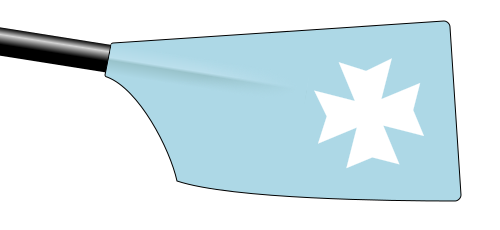 |
| Macon | A slightly rounder version of the square blade. These are pretty rare to see nowadays, having been pushed out by the faster and more efficient cleaver design. | 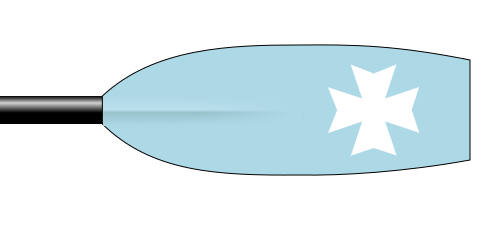 |
| Square | The original shape from the 1800s, now very rarely seen. Very long and thin, and made out of wood. | 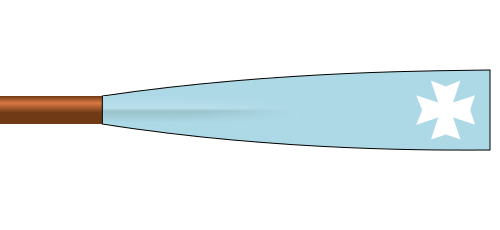 |
Types of cleaver blade
Within the category of cleaver, there are several subcategories. This market is pretty comprehensively dominated by Concept2, so it makes sense to simply link to their page on the matter.
Types of grip
Although there are a vast number of options out there, most clubs use one of the general categories of microfibre suede, rubber, or wood.
- Microfibre is very comfy, can get slippery if very wet and sometimes sheds, particularly when old. Requires more regular replacement.
- Rubber is extremely grippy (sometimes too grippy1) and very durable and easy to clean.
- Wood gets very slippy when wet and tends to be thicker than the other grip options. I’m personally not a big fan of wooden grips, but others like them.
Footnotes
-
I’ve never come away from an outing with rubber grips without new blisters. Then again, maybe my hands are just being babied by microfibre and need to toughen up a bit! ↩